· · 14 min read
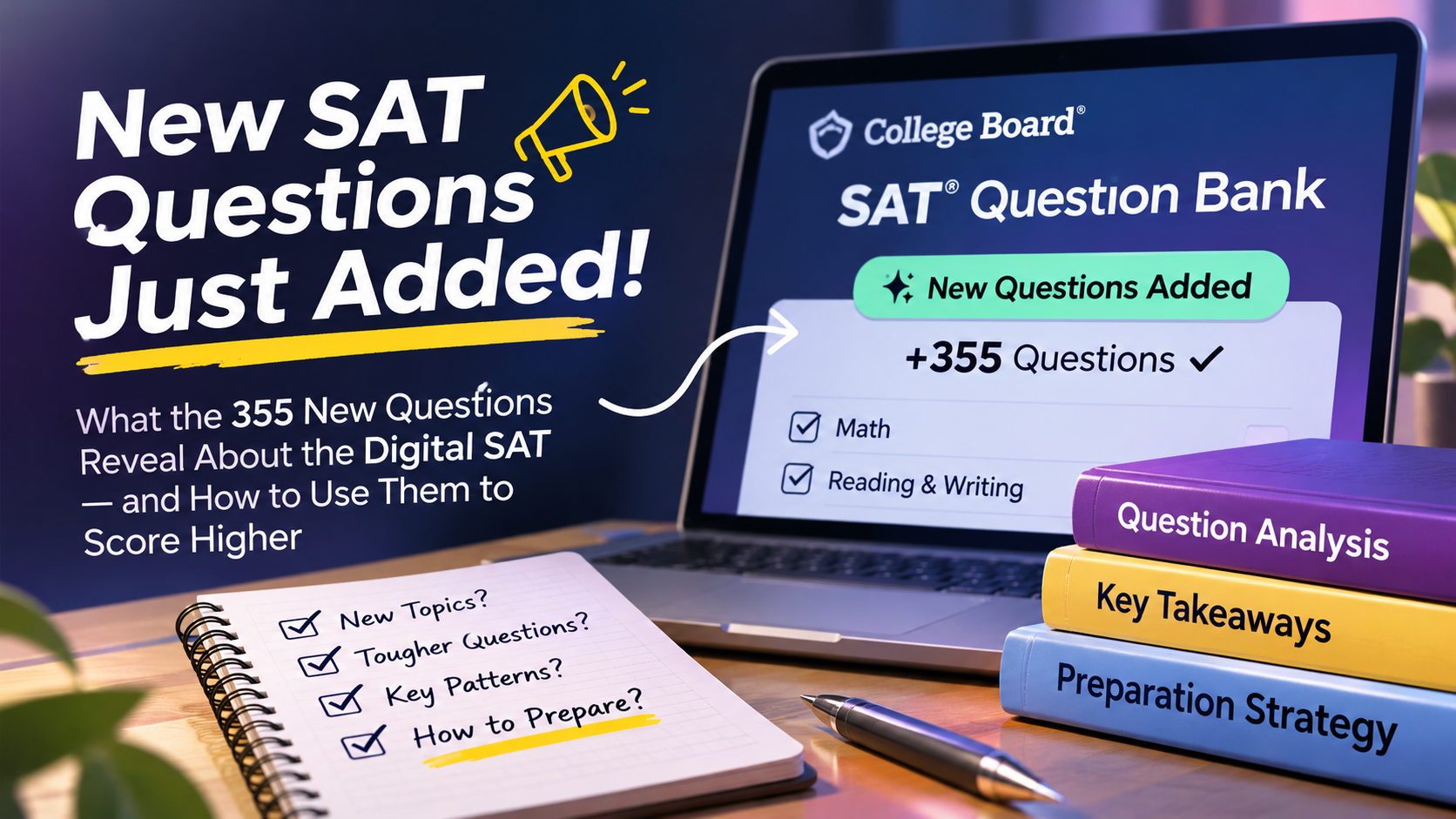
The Digital SAT Question Bank received a significant update on November 23, 2026, with 355 new practice questions across Math and Reading and Writing. But what do these questions actually tell us about the skills students need to master? We analysed the new questions to identify the patterns, challenging topics and preparation strategies that SAT aspirants should pay attention to.
If you are preparing for the Digital SAT, there is some important news worth knowing.
On November 23, 2026, College Board added 355 new questions to its official SAT Question Bank. The update includes 170 Math questions and 185 Reading and Writing questions, providing students with a fresh set of official practice material.
At first glance, this might seem like just another addition to an already extensive question bank.
However, a closer examination reveals some interesting patterns.
The new questions cover everything from linear functions and nonlinear equations to scientific reasoning, evidence-based reading, contextual vocabulary and rhetorical synthesis. More importantly, several of the challenging questions test a student's ability to interpret information and apply reasoning rather than simply recall a formula or grammatical rule.
We examined the new question sets across all four Math domains and all four Reading and Writing domains to understand what students should focus on.
Here is what we found.
1. What exactly changed in the November 2026 SAT Question Bank update?
The November 23 update introduced 355 new questions, distributed across the two main sections of the Digital SAT.
| Section | New questions |
|---|---|
| Math | 170 |
| Reading and Writing | 185 |
| Total | 355 |
The difficulty distribution is also worth examining.
| Difficulty | Number of questions | Percentage |
|---|---|---|
| Easy | 175 | 49.3% |
| Medium | 102 | 28.7% |
| Hard | 78 | 22.0% |
Almost half the newly added questions are classified as Easy, while approximately 22% are classified as Hard.
This is a useful distinction for students.
The addition is not exclusively about introducing extremely challenging questions. It also provides more opportunities to practise foundational concepts, improve accuracy and develop consistency.
Important: This is an update to the official practice Question Bank. It does not, by itself, indicate a change in the SAT syllabus, examination format, scoring system or difficulty of future examinations.
2. SAT Math: Which topics received the most attention?
The 170 new Math questions are spread across four domains.
| Math domain | Questions | Share |
|---|---|---|
| Algebra | 63 | 37.1% |
| Advanced Math | 45 | 26.5% |
| Problem-Solving and Data Analysis | 43 | 25.3% |
| Geometry and Trigonometry | 19 | 11.2% |
Three observations stand out.
First, Algebra accounts for the largest share of new questions.
Second, Advanced Math and Problem-Solving and Data Analysis together account for more than half the new Math questions.
Finally, Geometry and Trigonometry have the smallest representation in this particular update.
Let's examine each area.
Algebra: Linear equations and functions remain important
With 63 new questions, Algebra has the largest representation in the November update.
The questions cover:
Linear equations in one variable.
Linear equations in two variables.
Linear functions.
Systems of linear equations.
Linear inequalities.
One interesting feature is the use of real-world situations to test mathematical understanding.
For example, a question involving a satellite's altitude asks students to interpret a mathematical expression describing how the satellite's altitude changes over time. Another question presents a situation involving two different gas mixtures and asks students to identify the system of equations that represents the information. These questions demonstrate why understanding the underlying relationship between variables is important. Students should be comfortable translating word problems into equations, interpreting slopes and intercepts, and understanding what different expressions represent.
Preparation tip: Practise linear functions and systems of equations using both conventional mathematical problems and real-world applications.
Advanced Math: Understanding nonlinear relationships
The Advanced Math domain received 45 new questions.
The questions include:
Nonlinear equations in one variable.
Systems of equations involving nonlinear relationships.
Nonlinear functions.
Exponential relationships.
Some of the more challenging questions require students to interpret graphs and understand how changing a parameter affects a function. Others test the number of possible solutions to systems of equations. This is where memorising procedures alone may not be enough. Students should understand how equations, graphs and functions are connected.
Preparation tip: Spend time interpreting quadratic and exponential functions, understanding their graphs and practising systems of equations with multiple possible solutions.
Problem-Solving and Data Analysis: A domain students should not underestimate
The 43 new questions in this domain make it one of the most interesting parts of the update.
The questions cover:
Ratios and proportional relationships.
Rates and unit conversions.
Percentages.
Probability and conditional probability.
Statistical distributions.
Mean and median.
Scatterplots and mathematical models.
Some of the Hard questions deserve particular attention. For example, one question asks students to reason about how adding a new data point affects a line of best fit. Another examines how removing an incorrectly recorded data point changes a quadratic model. There are also questions involving how adding an observation can affect the mean and median of a dataset. The common theme is that students must understand how mathematical relationships behave when the underlying information changes. This is different from simply calculating an average or substituting values into a formula.
Preparation tip: Practise interpreting tables, scatterplots and statistical distributions. Pay particular attention to questions involving changes to datasets and their impact on statistical measures.
Geometry and Trigonometry: Don't ignore the fundamentals
Geometry and Trigonometry received 19 new questions.
The questions cover:
Area and volume.
Right triangles and trigonometry.
Lines, angles and triangles.
Some of the challenging questions involve three-dimensional geometry, similarity and determining whether sufficient information is available to establish triangle congruence. Interestingly, the new set does not contain circle-geometry questions. However, students should absolutely continue practising circles and other geometry concepts from the existing official question bank. The absence of a topic in one update does not mean it will be absent from the actual examination.
Preparation tip: Revise geometry formulas, similarity, congruence, right triangles and trigonometric relationships. Focus on understanding when and how to apply a particular relationship.
3. SAT Reading and Writing: The biggest lessons from the new questions
The Reading and Writing section received 185 new questions, slightly more than the Math section.
These questions are divided across four domains.
| Domain | Questions |
|---|---|
| Information and Ideas | 54 |
| Craft and Structure | 50 |
| Expression of Ideas | 40 |
| Standard English Conventions | 41 |
| Total | 185 |
The most interesting observation is the number of questions testing reasoning and evidence-based comprehension.
Let's look at the individual skills.
Information and Ideas: Evidence and inference deserve attention
This domain contains 54 new questions.
It includes:
Central Ideas and Details: 14 questions.
Command of Evidence: 27 questions.
Inferences: 13 questions.
Command of Evidence is particularly interesting.
The questions ask students to evaluate whether a statement supports a claim, interpret graphs and research findings, and identify evidence that strengthens an argument. For instance, one question discusses the literary form known as autofiction and asks students to identify evidence supporting the classification of a particular novel as an example of that form. Another uses a graph comparing readers' enjoyment of stories when they have been exposed to spoilers and when they have not. Students need to understand the claim being made and identify the information that directly supports it. Inference questions present a different challenge. Students are given information and asked to identify what can logically be concluded from it. The passages cover topics such as ancient Mesopotamian settlements, coffee farming, early human adaptation and scientific research. One particularly interesting question discusses archaeological and fossil evidence from an ancient human settlement in Ethiopia. Students must infer that early humans adapted their food-gathering behaviour in response to environmental challenges. The correct conclusion is not simply stated in the passage. It must be derived from the information presented.
What should students do?
Practise identifying the central claim in a passage, distinguishing evidence from assumptions and drawing conclusions that are directly supported by the text.
Do not select an answer simply because it sounds scientifically or historically plausible.
Craft and Structure: Vocabulary is only part of the challenge
This domain contains 50 questions.
Words in Context accounts for 31 of them, while Text Structure and Purpose accounts for 15. Cross-Text Connections contributes another four.
The new vocabulary questions are particularly interesting because they test contextual understanding rather than isolated word definitions. For example, a question based on Edward Gibbon's memoirs asks students to determine the meaning of the word "betraying" in a particular context. Another question uses an excerpt from Alice Wong's memoir and asks students to interpret what she means when she describes herself as "composing." The lesson is simple: knowing the dictionary definition of a word does not guarantee that you will understand how an author is using it.
The Text Structure and Purpose questions also deserve attention. Students must understand why a particular sentence appears in a passage, how an example supports an argument, or what the author is trying to communicate.
Cross-Text Connections requires students to compare two short passages and identify areas of agreement or disagreement between their authors.
What should students do?
Read beyond the missing word or underlined sentence. Understand the overall context, the author's argument and the relationship between different parts of the passage.
Expression of Ideas: The importance of logical communication
This domain contains 40 new questions.
It includes:
Transitions: 19 questions.
Rhetorical Synthesis: 20 questions.
Rhetorical Synthesis is especially interesting because students are presented with research notes and asked to select the statement that best accomplishes a specific communication objective. One question discusses the composition of graphite and carbon nanotubes. Students must select the statement that most effectively highlights the difference between the two materials. Another presents information about the Six Triple Eight, a predominantly African American women's military unit that processed a substantial backlog of undelivered mail during World War II. The student must identify the statement that best emphasises the efficiency of the unit. These questions are not about choosing the longest or most sophisticated sentence. They are about identifying the information relevant to the stated objective and communicating it accurately.
The Transitions questions test the logical relationship between sentences.
Students need to recognise whether a sentence introduces a contrast, provides an example, explains a consequence, adds information or clarifies an earlier point. Memorising a list of transition words is not enough if the student cannot understand the relationship between the ideas.
What should students do?
Practise identifying the exact objective of a rhetorical synthesis question before looking at the answer choices. For transitions, focus on the relationship between the two surrounding ideas rather than trying to insert a familiar connector.
Standard English Conventions: Grammar and punctuation still matter
The 41 new questions in this domain cover:
Boundaries: 20 questions.
Form, Structure and Sense: 21 questions.
The questions test punctuation, sentence boundaries, verb forms, pronoun references and grammatical structure. Some questions require students to distinguish between statements and questions, while others test their ability to identify the appropriate punctuation or verb form. These questions may appear relatively straightforward, but careless reading can lead to unnecessary mistakes.
What should students do?
Revise sentence boundaries, punctuation, subject-verb agreement, verb forms and pronoun references. Practise identifying the grammatical structure of the entire sentence rather than focusing only on the missing portion.
4. Are the new SAT questions becoming harder?
This is probably one of the most important questions students will ask.
Of the 355 new questions:
175 are classified as Easy.
102 are classified as Medium.
78 are classified as Hard.
Approximately 22% of the questions fall into the Hard category. However, there is an important distinction between the difficulty of questions in the practice bank and the difficulty of an actual SAT.
The Digital SAT uses a multistage adaptive testing system. Each section has two modules, and performance in the first module influences the difficulty of the second. This means that students need to be prepared for a range of question difficulties. A student who can solve only straightforward questions may struggle when the second module becomes more challenging. Equally, a student who can solve difficult questions but makes avoidable mistakes on foundational concepts may not perform as well as expected.
The objective should be to develop accuracy across all difficulty levels, not simply to master Hard questions.
5. How should students use the 355 new questions in their SAT preparation?
Simply attempting all 355 questions is not necessarily the most effective preparation strategy. The better approach is to use the new questions to identify weaknesses, improve specific skills and develop consistency.
Here is a practical approach.
Step 1: Begin with a diagnostic assessment
Before starting the new questions, take a full-length Digital SAT practice test. Identify your performance in Math and Reading and Writing. More importantly, identify the skills where you are consistently making mistakes. For example, a student may be comfortable with Algebra but struggle with data interpretation. Another may have strong grammar skills but find Inference and Command of Evidence questions difficult. These students should not follow identical practice schedules.
Step 2: Prioritise your weakest skills
Use the new questions to target the areas where you need improvement.
For Math, consider prioritising:
Linear functions and equations.
Nonlinear functions.
Ratios and proportional relationships.
Statistical reasoning.
Probability and data interpretation.
For Reading and Writing, pay particular attention to:
Command of Evidence.
Inferences.
Words in Context.
Text Structure and Purpose.
Rhetorical Synthesis.
Transitions.
These are useful starting points, not a prediction of which skills will appear most frequently on your examination.
Step 3: Attempt Hard questions strategically
Once you have established accuracy in the foundational concepts, start working through the Hard questions. Do not just check whether your answer was correct. Understand why the correct answer works and why the other options are incorrect. This is particularly important for inference, evidence-based reasoning, statistical interpretation and nonlinear mathematical relationships.
Step 4: Maintain an error log
Record the questions you get wrong and categorise the mistakes.
For example:
| Mistake type | What to investigate |
|---|---|
| Conceptual error | Did you misunderstand the underlying concept? |
| Misinterpretation | Did you misunderstand the question or passage? |
| Calculation error | Did you make an avoidable mathematical mistake? |
| Reasoning error | Did you select an answer that wasn't supported by the evidence? |
| Time management | Did you rush or spend too long on a question? |
Review this log regularly.
It can reveal patterns that would otherwise go unnoticed.
Step 5: Return to full-length practice tests
After working on specific skills, take another full-length practice test. Compare your performance and assess whether your accuracy, consistency and time management have improved. Remember that attempting additional questions is not the same as improving your score. The objective is to make fewer mistakes when encountering unfamiliar questions.
6. Where can students find the 355 new official SAT questions?
Students can access the official College Board SAT Question Bank here:
College Board – Official SAT Question Bank
To locate the new questions:
Open the official Question Bank.
Select SAT.
Choose the relevant section: Math or Reading and Writing.
Select the appropriate domain and skill.
Choose the difficulty level.
Search for the question IDs in the relevant question list.
The Question Bank allows students to filter practice questions according to their preparation requirements.
We recommend using the official material alongside full-length Digital SAT practice tests.
7. What does this update mean for students targeting 1400 or 1500+?
For students targeting 1400+, the most important lesson is that preparation needs to go beyond understanding the syllabus. Students need to demonstrate accuracy, reasoning and the ability to apply concepts in unfamiliar situations.
A strong Math student should be able to interpret data, understand functions and translate word problems into mathematical models.
A strong Reading and Writing student should be able to identify evidence, draw accurate inferences, understand contextual vocabulary and recognise the logical structure of an argument.
Students targeting 1500+ should pay particular attention to reducing avoidable errors while developing the ability to handle challenging questions. There is no shortcut that guarantees a particular SAT score. But a structured preparation strategy, regular diagnostic assessments and detailed analysis of mistakes can make preparation considerably more effective.
8. Final thoughts: More practice is useful. Better preparation is essential.
The addition of 355 questions to the official SAT Question Bank is a welcome development for students preparing for upcoming examinations. The new material provides additional opportunities to practise important Math and Reading and Writing skills. But the real value of this update lies in how students use it. Attempting hundreds of questions without understanding mistakes can produce very little improvement. A more effective strategy is to identify weaknesses, practise deliberately, understand the reasoning behind correct answers and evaluate progress through regular assessments.
The students who benefit most from the new questions will not necessarily be those who solve all 355. They will be those who understand what each question teaches them.
At Wizius Careers, we believe effective SAT preparation begins with understanding the student, identifying specific areas of improvement and developing a preparation strategy around those needs.
Whether you are aiming for 1300, 1400 or 1500+, the goal should be to prepare with purpose rather than simply practise more.
Better Prep. Better Scores. Better Schools.
Frequently Asked Questions
1. How many new SAT questions did College Board add in November 2026?
College Board added 355 new questions to its official SAT Question Bank on November 23, 2026. These include 170 Math questions and 185 Reading and Writing questions.
2. Are the new SAT questions harder than the existing questions?
The November update contains 175 Easy, 102 Medium and 78 Hard questions. These are the Question Bank's difficulty classifications and should not be interpreted as evidence that the actual SAT has become easier or harder.
3. Which Math topics have the most new SAT questions?
Algebra has the largest allocation, with 63 questions, followed by Advanced Math with 45, Problem-Solving and Data Analysis with 43, and Geometry and Trigonometry with 19.
4. Which Reading and Writing skills should students pay attention to?
Command of Evidence, Inferences, Words in Context, Text Structure and Purpose, Rhetorical Synthesis and Transitions are among the skills represented in the new material.
5. Should students attempt all 355 new SAT questions?
Not necessarily. Students should first identify their weaker skills and prioritise questions that address those weaknesses. They should also continue using existing official practice material and full-length tests.
6. Does the November 2026 update mean that the SAT syllabus has changed?
No. The addition of new questions to the official practice bank does not establish a change in the SAT syllabus, examination format or scoring system.
7. Where can I practise the new SAT questions?
Students can access the free official SAT Question Bank at https://satsuiteeducatorquestionbank.collegeboard.org/ and filter questions by section, domain, skill and difficulty.
8. How can I prepare for a 1400+ SAT score?
Start with a diagnostic assessment, identify skill-level weaknesses, practise targeted questions, analyse mistakes and regularly take full-length timed practice tests. A structured preparation plan is more useful than attempting questions randomly.